Friday, January 10, 2025

Dr. Layli Maparyan, a New Face of the University of Liberia


In 2004, I was a few months into my University of Liberia life when I experienced my first taste of campus riot. This time, it was the result of faculty and students resisting the appointment of Dr. Al-Hassan Conteh, citing that he was an “outsider” to the University. I was tear-gassed by UNMIL police officers and from that day, I changed my mind set about the safety of students one the campus – I had to always be ready anytime.

Fast forward to 2009, Dr. Emmet A. Dennis was appointed as president of UL, and again there was disagreement over his appointment as some faculty and students lamented that he wasn’t a graduate of the University. As I have learned, it has been a long-standing tradition of the University to hire an alum of the university as president. A reason for holding on to this tradition, as I have been told, is that if one has felt the “struggles” as a UL student, he/she certainly shares something in common with most of the faculty and students, and that automatically guarantees their success. Well, I think that’s a debatable concept but I ‘ll leave it for the “experts” of UL politics. Contrary to traditions, Dr. Emmet Dennis went on to lead the University to becoming a safe and welcoming environment for all. During Dr. Dennis' tenure, he opened doors for faculty and students to exchange experiences which attracted scholars like Dr. Layli Maparyan who would later begin discussions for a Gender Studies program at UL.


I met Dr. Layli Maparyan in 2009 when she visited Liberia with a mission to contribute to our national development agenda, specifically in areas of gender studies. Between 2009 and 2010 as gender studies program development leader, Dr. Maparyan had a series of discussions for the development of a gender studies program at University of Liberia. Her approach was focused on engaging stakeholders such as students, faculty, administrators, civil society, partners, and the government of Liberia. She met and discussed with students at the famous UL Palava Hut, sat in lecture rooms and engaged faculty and students and discussed gender issues and how they could be factored into the curriculum. On one of those days with Dr. Maparyan, we rode together to the UL Fendall Campus alongside the then smartly dressed ULSU representative to UL administration at the time, now Dr. Augustus Panton. I quietly sat and listened to Drs. Maparyan and Panton discuss a variety of issues. At Fendell, Dr. Maparyan stood before a half-filled auditorium and had an interactive discussion with students on gender studies and gathered students’ perspectives. These engagements, I strongly believe, gave her some perspective of the challenges in and out of the classroom at the University of Liberia. After years of collaborative work with key stakeholders, a College of Gender Studies and Interdisciplinary Research was launched in 2019.


Over the years, Dr. Maparyan has served in several roles that have had great impact on higher education in Liberia. From 2010 to 2012 she served as Chair of the Board, University Consortium for Liberia (UCL), a nonprofit organization focused on coordinating diverse academic efforts between Liberia and the global community. She returned to board duties in 2021 and has since made significant effort in attracting funding to the organization. Since 2009, the UCL has collaborated with students, university faculty, and other academic professionals and strategic international partners to increase learning in Liberia and the United States. I had the distinguished honor of being a UCL scholar and serving, as the only student, on the board of the UCL for 6 years. As Executive Director of the Wellesley Centers for Women (WCW) at Wellesley College, Dr. Maparyan has recently been between the US and Liberia working on a 5 million USAID funded project, the Higher Education for Conservation (HECA) where she serves on curriculum development for soft skills, forestry biodiversity and conservation as well as gender, equity, and social inclusion lead expert. I was fortunate to have been part of the initial team led by Dr. Maparyan to develop the proposal for the 5 million USAID grant. I must say that I learned a lot working with Dr. Maparyan. Her attention to details, professionalism, ability to demystify complex scenarios and overall, her excellent communication and leadership qualities are few of her unique attributes.


Having known and worked with Dr. Maparyan for more than a decade, it was no surprise to me that President Joseph Boakai, after a comprehensive search for a new president, appointed her as the 16th President of the University of Liberia. I believe she will become the NEW FACE of the University of Liberia considering her active engagement with the University of Liberia community in areas of significant needs for the last 15 years. I trust that she’ll be actively engaged with the campus community, encourage excellence in various academic fields, represent the University of Liberia positively and restore a system of order that is so desperately needed for a well-functioning UL. In her inaugural speech today, she outlined her values in her capacity as president of UL, the FIVE Es (Education, Effectiveness, Efficiency, Excellence and Ethics). As someone who has taught at colleges and Universities in the US such as Spelman College (Dr. Maparyan’s alma mater), Kennesaw State University and now an adjunct at Howard University in Washington DC, I share similar values and here are my perspectives of each.


Education: An educator once said that “education is not merely bookish facts but the fundamental ability to think clearly.” To uphold this value, we need to reimage teaching and learning at the University of Liberia where knowledge, skills (hard and soft) and positive dispositions become the core elements of teaching, learning and career development. Our faculty must tailor their teaching to active engagement of students with the materials, encourage them to analyze, evaluate and synthesize information through research, writing and classroom discussions. The enabling environment must be available where students have access to diverse knowledge and perspectives. Also, adapting a student-centered teaching and learning philosophy, I believe, will prepare our students for lifelong learning and responsible citizenship.


Effectiveness: effectiveness of the university of Liberia’s faculty and staff will be a key determinant of measuring students' learning outcomes and their success. Effectiveness should focus on learning outcomes and students’ success that align with teaching objectives. Being effective must have a student-centered approach as they are the reason the faculty and administrators have their jobs. As there are growing needs of students in today’s job market, career/professional development that focuses on developing students’ soft skills must be factored into the university’s strategic plan for the next 4 years.


Efficiency: One of the biggest challenges the University of Liberia faces is the unnecessary bureaucratic process which, I believe, has rendered the University inefficiency in most if not all its administrative and academic operations. The university needs to make maximum use of resources available to them. Speaking of resources, the Government of Liberia must increase the UL budget to an amount that will sufficiently support the FIVE Es. Academic calendar, as Dr. Maparyan stated in her inaugural speech, must be predictable and respected so that students, faculty, and support staff can plan effectively. In addition, administrative processes that lead to entrance and exit of students need to be streamlined to conform to 21st century academic efficiency. Also, the university must ensure efficient optimization of technology to boost teaching and learning experiences of faculty and students.


Excellence: to uplift operational excellence, the university must foster a culture of continuous improvement in and out of the classroom. The standards for excellence must be set from the admission of students to their graduation. Additionally, faculty must adhere to prescribed teaching and research quality that support students’ careers. In the end, acknowledgement and reward for outstanding faculty and students’ achievements should be a symbol of excellence.


Ethics: It is a well-known fact that the University of Liberia has struggled with adhering to ethical academic and administrative practices. A failure in any one of the previous Es, I think, will have a trickle-down effect on ethical practices. Upholding academic integrity and responsible conduct of research and teaching as well as administrative practices, from the office of the President to the student community, will measure the outcome of the values of Education, Effectiveness, Efficiency, Excellence and Ethics at the University of Liberia.


While I have a strong conviction that Dr. Maparyan will succeed in restoring a system of order at the University of Liberia, it must be important to note that this is a shared responsibility of the faculty, staff, students, civil society, and the Liberian government.


Saki Golafale, Ph.D.

Former UCL Board Member and UCL Scholar

Maryland, USA

Tuesday, December 26, 2017

Ellen Johnson-Sirleaf: The anger that may have revealed itself at the ballot box


On December 24, 1989, change revealed itself to Liberia through the uncompromising power of BULLETS that took away the lives of about 250,000 people. Interestingly, Liberia's president, Ellen Johnson-Sirleaf was an engineer of the revolution at the time. Exactly 28 years after, change revealed itself again, but this time, through the BALLOTS. Liberians went to the run-off election on December 26, 2017, to elect a new president to replace outgoing president Ellen Sirleaf. The run-off was between soccer legend George Weah of the Coalition for Democratic Change and Vice President, Joseph Boakai of the ruling Unity Party.

Whoever president Sirleaf-Johnson voted for is her privacy, but the facial expression seen in this photo sent out a strong message. Voting, I think,  should be a joyful expression of everyone's political will which determines who leads and who does not.  When one wears a facial expression, like that of President Ellen Johnson-Sirleaf's while making a conscious decision, to me, sends a strong message of anger, and as the songwriter says, "don't make a decision when you're mad (angry)". The anger that she wore didn't derive from being deprived of self-worth or basic social services like the ordinary Liberians. It definitely didn't come as a result of not ending her two terms in office. As a president for 12 years, it should have been a happy moment, but for Ellen, it didn't seem. Many questions may arise from this photo considering the last months of political rivalry and electoral problems in Liberia. Regardless of President Sirleaf's facial expression, a vote was cast and a winner and a loser will be determined in two days when the National Elections Commission announces the results.

Before my next article on this issue, I will speak to a psychologist on how voting with anger impacts a conscious decision.

And the winner is...

The winner is...


Saturday, December 9, 2017

Education is a key ingredient for acquiring political knowledge and leadership


By Saki T. Golafale


"Being academically knowledgeable" or "to know book" as it is said in Liberia, has become a major point of discussion in our body politics. One group of people has condemned the essence of academic education as a basic requirement for political leadership while another group holds onto the belief that education matters for political leadership, especially for the presidency. 

When Senator George Weah stepped into the presidential race in 2004, it wasn't strange to many who followed our politics during the Charles Taylor's era when it was rumored that Mr. Weah was eying the presidency. Very soon, while Liberians were still nursing the agonizing experiences from the war, they were faced with the huge task of deciding between a highly educated Ellen Johnson-Sirleaf and a football icon, George Weah, who barely had a high school education. Did education matter by then? To many, it didn't matter. However, the result of the 2005 elections did answer some questions. Whether it was based on the lack of solid education and political experience that robbed Mr. Weah the chance to lead one of the poorest countries in the world or it was Mrs. Sirleaf's highly rated and energized campaign that handed her the golden opportunity of becoming Africa's first elected female president, the result of 2005 presidential election does matter to Liberians. Mr. Weah's loss to Mrs. Sirleaf in 2005, regardless of how history records it, has, to a greater extent, influenced Liberia's democracy. A democracy where the debate over who is educated or politically educated to lead is still ongoing. 

An evidence to this is Mr. Weah's cognizance of his limited education to lead which might have prompted his decision to further his education. After 13 years, the essence of education to political leadership still remains a debate. Mr. Weah now presents himself as a bachelor and masters degrees holder, which were missing from his CV in 2005. He has also represented the people of Montserrado in the Senate for three years. On the other hand, Vice President, Joseph Boakai, with a BA degree, presents a long list of public service experience, including being vice president for 12 years. As Abraham Darius Dillon would say, "going by academic credentials Weah is or should be more educated than Boakai". Whether  Mr. Dillon was being sarcastic or not, this is a fact. Does the difference in academic credential end the debate of educated vs uneducated? It certainly doe not! Mr. Weah has been labeled as "uneducated" by some of his supporters and nonsupporters despite his reportedly "earned" degrees. A recent outburst of social media posts by Liberia's education minister, George K. Werner, in support of Mr. Weah confirms this. For this, Mr. Werner has been condemned in many quarters and labeled "unqualified" to serve as minister of education. Contrary to Werner's argument. Weah reportedly went to "school" to get himself prepared for the presidency. 


It is generally known that acquiring academic degree differs from being considered "educated". While education is not only about academic papers but also about how one conducts himself for the general good of society, three university professors define education as not merely of bookish facts but the fundamental ability to think clearly. Does Mr. Weah think clearly before he speaks? Do his statements correlate with what he does politically? The evidence of Weah's poor output unveils every time he speaks in public or on an interview. His thoughts on important issues drift far apart from reality and make one question his political judgment and his ability to lead. 

In recent times, Mr. Weah told Liberians that "protecting Elen Johnson-Sirleaf" is his most important agenda as president. He has also expressed his desire to support Robert Sirleaf's bid for the Senate if he joins his CDC party. More interestingly, his criticism of the Sirleaf's government has naturally died and recently went on to grade her government 80%, something many political pundits rated him low. On his sharpness on socioeconomic issues, Mr. Weah has presented one of the most wired economic approach to budget shortfall as seen directly quoted below (unedited).


" When rice is expensive and you know da you got a shortfall in the budget, then reduce the price of rice so those who all da na even working but can make ends meet can buy it. So dor when there shortfall, we can na again support scarcity. You understand? What need to be done for allor us because we have a responsibility."


It is mind-boggling to think that Mr. Weah was serious when he made those statements, but his body language, as seen in this video confirms his seriousness at the issue. Additionally, Mr. Weah's speeches, to a greater extent, makes no sense to many. His famous speech in Nimba County and many others are reasons to condemn Weah's master's degree. While his education remains a question, his political education also remains blurry as "education is a key ingredient for acquiring political knowledge" in this modern time. Has Mr. Weah acquired political knowledge to lead Africa's oldest republic? Has Mr. Weah demonstrated his ability to lead based on proposed policies as a real political leader would do? Certainly not!

We must be glad to know how education has influenced our nation and the democracy we enjoy, but the question of who is "educated" or "uneducated" and politically knowledgeable to lead will continue to surface in our body politics. We haven't reached a point in our history where people are punished for being "educated" or "uneducated". But we have reached a point where we can collectively set standards as to who leads and who does not. While Mr. Weah himself has not publically agreed that he lacks solid education and knowledge of political leadership, despite his embarrassing and distorted speeches, it is evident that Weah's continuous expression of his ignorance of political leadership has resonated with many, and that for which, voters will have on their minds at the ballot box.


About the author: Saki Golafale holds a BSc. degree in chemistry from the University of Liberia and is currently a Ph.D. candidate at Clark Atlanta University where his research focuses on functional materials for gas adsorption and photochemistry. He hails from Grand Cape Mount County, Liberia. He can be reached via email at stgolafale@gmail.com 

Friday, December 8, 2017

Snowfall in Marietta Georgia

An unexpected snow day in Marietta, Georgia where I spent time shooting photos and videos of anything that had snowflakes.  It was an amazing experience. I made a short video with photos and thought to share with you. What a day it was!
Me building snow tower on my car


Stop Snow Now!


I know this might sound stupid to most people, but I am making a global call to STOP SNOW NOW. 😂

Nature's Beauty


When nature makes a blend, its beauty pops out. Snowfall in Marietta, Geirgia, on this Christmas tree, in my back yard, looks so amazing and speaks to the mouthwatering beauty of nature. 

Thursday, December 7, 2017

Supreme Court of Liberia: Run-off Election Despite Challenges of Fraud


The Supreme Court of Liberia, today, ruled for a run-off election despite a challenge from Liberty Party's Charles Brumskine that the October 10 poll was graced by massive fraud and irregularities. The ruling automatically gives the National Elections Commission (NEC) the authority to schedule a run-off election between football legend, now Senator, George Weah of the Coalition for Democratic Change, and incumbent Vice President Joseph Boakai of the Unity Party.  Senator Weah reportedly received 38% of the total votes in the October poll while Vice President Boakai and Cllr. Charles Brumskine received 28% and 9.6% respectively. Cllr. Brumskine of the Liberty claimed that the October 10 election was not handled in accordance with the constitution of Liberia, and he called for a re-run. The Unity Party had also challenged the October 10 results. A hearing held at the National Elections Commission dismissed both LP/UP claims of fraud and irregularities. Upon the dismissal of the case by NEC board of commissioners, the aggrieved parties took an appeal to the Supreme Court of Liberia. The ruling from the Supreme Court rests on the provision of insufficient evidence being provided by LP/UP to nullify the October 10 election.

The winner of the run-off, which will most like be scheduled this December, will replace Africa's first elected female head of state, Ellen Johnson-Sirleaf. Liberia has enjoyed peace for the last 14 years since the end of the country's 14 years civil war. This transition from Mrs. Sirleaf to either VP Boakai or Senator Weah will mark a historic transition in 70 years.

Saturday, November 18, 2017

Simplicity in style with Kay

Simplicity in style is Kay's theme for fashion and photo shoot. She reaches out for the simplest of clothing and chooses places with a vintage view for her photo shoot. Here, she rocks her photo world with a beautiful combination of beauty and creativity. To view more of Kay's simplicity in style photos, follow her on Instagram.


Simplicity in style: Vintage Kay on John Deere Tractor

Simplicity in style: Kay on a 1970  Plymouth Gold Duster

Sunday, November 5, 2017

Kay in Photos


Hello blog readers!

Kay is a short name for Kormassa, and I manage my Instagram account a Youtube channel. This week, I will be blogging about everyday life and other things that matter to people. To get the latest updates on issues of the week, follow me on Instagram and subscribe to my YouTube channel. I'll see you in my next blog post that you wouldn't want to miss. 

Thursday, September 4, 2014

AWAITING THE DEADLY VERDICT OF EBOLA OR NO EBOLA

By Boakai Golafale


On 3 September 2014, I came across a story posted on the FrontPage Africa website entitled “Carrier Doom- Senegal Raises Stake Over Ebola Transporters." The story is about the reaction of aggrieved government officials of Nigeria and Senegal who feel that their countries were infected by individuals who knew their EBOLA status but still chose to go abroad to infect others. Both are grim reminders of how Patrick Sawyer in Liberia and another Guinean student fled their countries to carry Ebola to countries before unaffected. It smacks of all the pains of betrayal, suspicion, anger, frustration and finger pointing. After reading this article, I am prompted in a similar fashion to bring the story to light about how a suspected Ebola patient now deceased was surreptitiously transported to a rural town in Cape Mount County thereby allegedly infecting more than 25 persons who are now awaiting the frightening and anxious result of a test to determine if they are Ebola positive or not. 

The township of Damballa is about an hour’s drive inland from Tiene which is the closest town to the Bo Waterside Liberian-Sierra Leonean border post. Even though the town has no economic significance such as the famous Lake Piso in Robertsport or the diamond rich Lofa Bridge, Damballa notwithstanding is of strategic importance to the people of Grand Cape Mount County in Western Liberia. Damballa is the biggest town in Porkpa District with a population of over 5000 persons. It has the biggest health center in the area with a 10 Bedroom clinic and a Junior High School that is being upgraded to a high school status. Additionally the town boasts a host of prominent personalities who have served in high government positions and in the private sector in past and present. The Late Supreme Court Judge Counselor Elwood Jangaba and his late brother Fmr Senate Pro Tempore Tambakai A Jangaba, Dr. Kanda Golafale, Fmr Asst Minister of Land and Mines Mr. James B. Konuwa and Chief Medical Officer of Firestone Hospital, Dr. Lyndon Mabande are few of the big names from this town. Since the outbreak of the deadly Ebola Virus in Liberia, the people of this rural town have remained for the most part unaffected by the ravages of the pandemic now raging in other communities in the county. Rumors only had it that an EBOLA related death had occurred in a nearby town, but so far it was only a rumor. But on a quiet Saturday evening on 30 Aug 2014 all this would change.
On that fateful day, unknown to most people a commercial vehicle arrived in Damballa around 6:30 PM in the evening carrying over 20 bags of rice and a very sick and helpless man called Mohammed Konneh. Unable to walk unassisted, the man famous in that part of the country as a commercial car driver was taken from the vehicle into a house on the back of another person. The story now unfolding states that prior to his arrival in Damballa, he has for than a week lain sick in the house in the Kuwait area near Duala Market having come in contact with a woman who tested positive for EBOLA and died. Whether his wife and another family member in Damballa knew these facts but ignored the warning signs and still sent for the man to be brought from Monrovia to Damballa for an herbal or country medicine treatment in such a state remains a mystery at this point.
But the truth now is when Konneh arrived in Damballa on that Saturday evening he was already in the advanced state of the disease. I received a call shortly from my brother in the town in an alarming voice saying to me that ‘Konneh has brought EBOLA to Damballa’. Before this he had called me every day to give an update on the state of the virus in that part of the country. Up to this point no one from the town has come in contact with the disease. So when Konneh arrived looking so weak and helpless, it did not go unnoticed. My source told me that before he was taken into the house for treatment, the patient was queried by the District Health Officer (DHO) in the town to determine if his case was Ebola related. The answer to five of the questions put to him all pointed to the disease. This notwithstanding, Konneh was taken into the house by his wife and other relatives including a man who administered the medication and helped to clean the mess that he made. It was revealed that for the next 24 hours or so he was subsequently bathed, fed and chalked down with country medicine and catered to. During this period it is said that his condition continued to deteriorate on a daily basis.
On Sunday 31 August 2014 afternoon the patient was showing all the symptoms of full blown EBOLA including severe diarrhea and vomiting with blood. It was at this point that the care givers became alarmed and abandoned the patient in the house. Consequently other people in the town who have been following the unfolding event moved in to immediately assess the situation and identify all those who have come in contact with the sick man. The number was well over 25 persons. These were quarantined in a separate building by health workers and local leaders who cautioned others not to make any further contacts with them until an Ebola Response Team (ERT) arrived in the town.
 As expected the Konneh’s condition did not improve any further until he died at 0230 hrs on Tuesday 2 September 2014. After his death locals in the town made several calls to the ERT to inform them, but just as it had been since Sunday when the man’s condition had begun to worsen, the answer to the calls were always ‘we are on our way’. But the team finally arrived around 1800 hrs on that Tuesday evening, removed the body, sprayed the house and buried the corpse with the assistance of locals using flash lights.
With that burial, the story of the man who brought the strange disease to Damballa might have come to an end. But the fate of countless number of people including the driver and more than 25 other persons with whom he came in contact remains a matter of grave concern at this moment. There have been conflicting reports that the vehicle that took him from Monrovia to Damballa has been impounded and the driver is on the run. But again at this point, it is just rumor.
The story of Mohammed Konneh and how he allegedly took this strange disease to Damballa is reminiscent of many others in West Africa especially Guinea, Sierra Leone and Liberia where EBOLA has ravaged the most. At this point let it just be called a strange disease because even members of the burial team who removed the remains of this man said that it would only be known that it is EBOLA after a thorough observation for a period of 21 days all the people the dead man came in contact with. But the whole saga only raises more questions now than answers. For instance why a man who showed clear symptoms of Ebola would be accepted by relatives for care when awareness about this disease is all over traditional and social media? Then again, how could he have crossed the vehicle checkpoints at Klay and Sinje where screening of all passengers are carried out by security and health workers for Ebola before being allowed to pass? A clear answer to these questions may never be known but one thing that is clear here is that people who have been saying that denial is a big factor in the spread of the Ebola virus in Liberia are just been proven one more time right. And for those who are awaiting the 21 days to know their status of whether or not they will come down with EBOLA, it is indeed like waiting for the verdict of a court trial whose sentence is already destined.


This article was written by Boakai Golafale, a native and concerned citizen of Damballa from an eyewitness account. Check FrontPage Africa website for article on “Carrier Doom- Senegal Raises Stake over Ebola Transporters.

For queries call Cell no. +231886947011 and Email: 1bogone@gmail .com

Wednesday, October 23, 2013

Breaking the Silence-Blogging from Atlanta

I have had a wonderful two months in the city of Atlanta where I am currently pursuing my graduate degree in chemistry at Clark Atlanta University. It has been a pleasure meeting and working with a friendly environment here at Clark Atlanta University. The welcoming smiles that cover every face makes a new-comer believe that no problem exists in this part of the world. Hey, that is an illusion; there is problem everywhere. However, it's hard to notice that someone is going through a problem except when you are told. The smiles and friendly expressions probably cover everything! I assume this is the opposite in Liberia as expressions on the faces of many can tell that something is going wrong or right. I missed Liberia!

Well, I am only breaking the silence as I have been missing on the blogoshpere for exactly a year since I last Posted on my blog. However, I expect to continue my blogging experience with focus on academic and environmental issues. Environmentally, I have been mixed with the current global issues-climate change, pollution and the rest. I recently attended the Power Shift conference in Pittsburgh, where about 10,000 people from across the United states converged to exchange views, learn new approaches and stand up against environmental injustices. Fortunately for me I had a short blog post while at the Power Shift conference!

Blog readers here I come again!

Friday, November 30, 2012

Monday, September 3, 2012

The struggle for Dominance in Post-Conflict Liberia-Old Order Versus New Order

Part I By Saki Golafale
Liberia as a nation has endured multiple social, political and economic turbulence which have resulted from the recklessness of the egoistic political elites of the dominant “Old Order.” Characterized by the greed for power and wealth, the political elites have conspicuously survived and have continued to survive on the Country’s plentiful but yet unmanageable and cursed resources. The unflinching thirst for power and luxurious living in the midst of offensively abject poverty, has led many members of the “Old Order” to ruthlessly undermine peace, justice and the rule of law. From generation to generation since Liberia became a sovereign state, the cruel legacy of the “Old Order” has transcended and remained dominant on the social, economic, and political market squares of Liberia and has interfaced and in conflict with, what is now called “The New Order.”
What do I mean by the phrase, “Old Order?" The Old Order is a social paradigm that espouses dominance in economic and political decision making with gross disregard to the statutes of democratic norms. Such social paradigm has survived because sons and daughters of the political elites of Liberia have indoctrinated their sons and daughters and those pitiful low class individuals who have unfortunately climbed the social ladder based on sympathy. The Old Order had emphasized on economic growth and development but sadly focusing on short term or immediate prosperity and at the same time encouraging conspicuous consumption without plans for future generation. Today
Liberia is fortunately old [165 years] but unfortunately underdeveloped or probable 165 years behind modernity. On the contrary, the New Order has come to decentralize economic and political decision making and encourage cooperation and partnership among citizenry with due regard to sustainable economic and political future of the society. The New Order has come to foster freedom of speech and association and the rights of women and children and the disabled community; and at the same time advocating for sustainable use of natural resources and avoiding damage to the ecosystem and endangered species. In short, the New Order, I think, is the only prescribed paradigm for building a sustainable society vis-à-vis Liberia.

Friday, December 23, 2011

When Lawlessness Prevails…

Few weeks ago, Liberians had a taste of electoral violence, an unlawful means of protest, which led to gun fire, also unlawful, and death(s); few days ago, some Liberians openly burned the Norwegian flag, another unlawful means which I think, signifies the declaration of war, in protest that President Ellen Johnson-Sirleaf didn’t deserve the Nobel Peace Prize; yesterday aggrieved students took to the streets to wage their anger on state authorities and which led to the damage of some vehicles and today, the violence continued. I stood saddened and regretful as I saw young Liberians, under the umbrella of aggrieved students which I still cannot believe, ragging havoc on government and private properties today in protest of their vacation job stipends. Standing about one hundred yards from the scene, I watched cars and window glasses of government buildings being damaged without remorse. The perpetrators called themselves “vacation job students,” something I still find very hard to believe that students will go out of their common senses when they feel disenfranchised about a process. The president intervened in yesterday's event and everyone thought the situation had calmed down, but it turned out to be worst. In response to the situation, the government of Liberia declared curfew from 10 p.m. to 6 a.m. Why will young people choose to express their concerns in such a gullible manner? Why will state authorities not avoid such happenings? When will some group of people learn how to express their concerns responsibly and when will authorities listen to these concerns and find a common ground, if any? When will Liberians respect the laws and state authorities? Is there something fundamentally wrong with our society? Is lawlessness prevailing in Liberia? Indeed, lawlessness is prevailing and Liberians in general need to understand who they are, where they come from, where they are presently, and where they want to go. Since the government of Liberia, through the Monrovia City Corporation, declared Christmas package for students,the selection process, which I witnessed, I felt it would have ended in a complete hullabaloo. The selection process incorporated non-students, most of whom were wayward street boys, which was against the nomenclature, “Vacation Job Students.” I also noticed some older men and women who have passed school going ages, demanding their stipends. This is totally unacceptable! State authorities need to be cognizant of administrative malpractices in any given situation. It was also noticed that many of the protestors did not work at all but are now demanding their benefits. THIS IS HIGHLY UNFAIR! How was the monitoring of workers done? Were there concerns about attendance and absenteeism? In my opinion, everybody involved is to be blamed as authorities need to learn how to begin and end processes in an orderly manner and aggrieved persons need to respect authorities and the laws and channel their concerns peacefully. If Liberians must restore the national systems of order, the law MUST prevail at all cost! When lawlessness prevails, these are the results to expect:

Sunday, December 11, 2011

Sellers Versus Buyers - A Game worth Playing

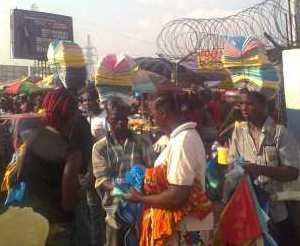
This time of the year in Liberia is usually marked by interesting exchanges in many forms between sellers and buyers. As sellers chant over their goods to attract buyers, buyers get confused as to who to buy from and how to avoid buying duplicate or poor quality products. Many low priced and poor quality goods are imported into the country at this time all because of the Christmas and New Year celebrations. What to buy and what to sell are the biggest questions buyers and sellers ask themselves as they go out to engage each other on a field with no referees. As I walked in the midst of a thick crowd in the Red Light market, I only saw myself surrounded by nothing but sellers. Their stinging breaths coupled with offensive sweat scents made me nauseated, but I could not hold my breath as I was curious to snap a photo of sellers and buyers using their intellectual bargaining powers to overcome each other. “Buy your whole year eating”. Buy it fifty; don’t buy it hundred, that whole year using”. “Buy clothes; don’t buy food”. “Spend money on clothes; don’t act cheap”. “How much, how much move from here”. These are chants that are usually heard in the jam packed Red Light market of Paynesville where many petty traders converge for their daily chores. Despite the courage and enthusiasm to sell, many sellers seem to be challenged by the huge number of sellers concentrated in one locality and selling mostly the same goods for very insignificant profits. Interestingly, not all sellers are real sellers. Some are defined criminals! The RULE OF THUMB IS DON’T SELL IF YOU CANNOT BUY, AND DON’T BUY IF YOU CANNOT SELL. In short, sellers are buyers as well as buyers are sellers.

Monday, November 28, 2011

"Pem-Pem Man Na Do it Again"

Pem-Pem motor cycles are a huge benefit to the transport industry in Liberia, but how ordinary Liberians consider pem-pem riders might be far from reality. A lot of accidents involving pep-pem riders occur on a daily basis in Monrovia, and the general conclusion is, pem-pem riders are always responsible. The perception many people have about pem-pem riders have shaped the thinking of even health workers who attend to injured pem-pem riders, yet these struggling people transport market women, professional people,students, and police officers to work, school or other places.sometimes the police often use pem-pem rders to track traffic violators. . Despite all of the good things about pem-pem riders, many still label them as criminals, careless drivers and more over NONE LIVING THINGS. Some who drive light and heavy vehicles are serious rivals to pem-pem to the extent that they [pem-pem] are delibrately knocked down while in the traffic. Some drivers claim that pem-pem should not be on the main road. All of these have been said based on today's incident which involved a truck driver and a pem-pem rider along with an immigration officer riding in the Duala area when suddenly a truck, TT 467, knocked the two down with the immigration officer, a lady, was seen with an injured leg and claiming that she could not walk all by herself. The pem-pem rider jumped and escaped while the lady suffered the consequences of a careless and wicked truck driver.Interestingly, I was also on a another pem-pem when I arrived on the scene, few seconds after the incident had occured."Pem-pem man na do it again", someone said from a crowd of onlookers. Guilty was the name of the pem-pem rider immediately after the accident. In monrovia, once an accident occurs involving a pem-pem rider, a conclusion is that pem-pem caused that accident. This is not fair and justice should be given to these hard working man who are a big help to the transport industry.
.
While it is true that pem-pem riders take advantage of the jammed traffic, some drive recklessly and even cause injuries to their passengers and sometimes pedestrans. Many issues surrounding traffic violations and passengers and drivers rights are yet to be addressed by the Liberia national Police. Professional judgement should not be based on how people in general feel about pem-pem riders. A fair play is needed!

Sunday, November 27, 2011

Saki is Back to the Bloggosphere!

I have been in the midst of many things and working and schooling at the same time. Since last year, I haven't been blogging on my personal blog and Ceasefire Liberia which I had used to get my stories and personal experiences to the outside world. However, I AM BACK! After graduating from college last year, i had to find a job, plan for graduate studies and work on other personal agandas. For these, I had to abandon the bloggosphere and a lot of things that connected me to people, places and events. Interestingly, I will be blogging from the eastern part of Monrovia, where i am originally from but i stayed away for five years in Paynesville City which is on the north of Monvovia. After five years of my stay in paynesville, I was able to link my social and professional life to the outside world through blogging, grassroot community actions, academic promotion and many more. I salute everyone who may have contributed to my stay in Paynesville. Memories will continue to live on especially the shared experiences during the 2011 elections period and the days of WOCYMES. I am back to the bloggosphere as a physically, emotionally and professionally changed man with experiences in promoting education, environmental advocacy and campaign, health promotion and politics. My social life should not be questioned as i am an atom of an omnipresent social molecule. Blogging controls part of my life, so let's get started again! Let me say thanks to Shelby Grossman and Ruthie Arkerman, founder of Ceasefire Liberia for inspiring me. Hats-off to you all!